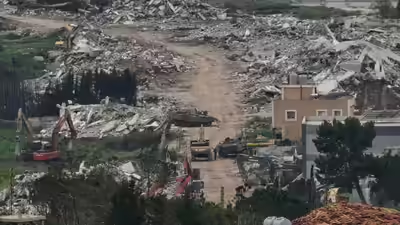
Tensions between the United States and Iran remain high despite a temporary ceasefire extension announced by US President Donald Trump. The move has delayed an immediate return to conflict, but major disputes over sanctions, maritime security, Iran’s nuclear programmed and military pressure continue to threaten the fragile truce. With diplomatic efforts shifting to Islamabad, global attention is focused on whether negotiations can prevent a wider regional crisis.
At the Centre of the standoff is the Strait of Hormuz, one of the world’s most important shipping routes. Nearly one-fifth of global oil supplies pass through the narrow waterway during normal conditions, making any disruption a major concern for energy markets. Iran temporarily closed the route during the conflict, causing sharp oil price movements and fears of supply shortages. Although the passage was briefly reopened, Tehran later shut it again after accusing Washington of violating the ceasefire through naval enforcement actions and the seizure of an Iranian-linked vessel.
Trump has defended the continued US blockade, saying it is necessary to pressure Tehran into accepting a formal peace agreement. He claimed Iran was losing hundreds of millions of dollars each day because of restricted oil exports and said the blockade would remain until Iranian leaders present a unified proposal. At the same time, Trump warned that if talks fail, military escalation could follow quickly, raising concerns across international markets and diplomatic circles.
Iranian leaders have rejected the US approach, accusing Washington of trying to force surrender through threats rather than pursuing genuine diplomacy. Parliamentary speaker Mohammad Baqer Ghalibaf said the United States wanted a “table of surrender” and warned Iran was prepared to reveal “new cards on the battlefield” if hostilities resumed. Foreign Minister Abbas Araghchi also criticised what he described as “provocative actions and repeated ceasefire violations” by the US. President Masoud Pezeshkian said meaningful negotiations require trust, consistency and respect for commitments.
Pakistan has emerged as a key mediator and is preparing to host a fresh round of talks in Islamabad. The United States is reportedly planning to send Vice President JD Vance, but Iran’s participation remains uncertain. Reports in Iranian state media suggest Tehran may boycott the summit because of what it sees as excessive American demands and inconsistent positions. Security in Islamabad has been tightened ahead of the possible meeting.
This live blog tracks every major development including ceasefire updates, reactions from Washington and Tehran, movements in oil markets, shipping activity in the Strait of Hormuz, and the latest from the Islamabad peace talks. With trust low and rhetoric intensifying, the coming hours could prove decisive for the Middle East and the global economy.
US Iran war: Zelenskyy warns Iran conflict could risk US missile defence supplies to Ukraine
Ukrainian President Volodymyr Zelenskyy has warned that a prolonged conflict in Iran could indirectly affect Ukraine’s access to critical US-supplied anti-missile defence systems, including Patriot interceptors.
In an interview with CNN, Zelenskyy said Ukraine has received limited quantities of such systems due to constraints in US production, though current supplies and intelligence flows have not been disrupted. He noted that Kyiv is procuring weapons through NATO’s PURL programme, which allows allied countries to fund purchases for Ukraine.
“Through this programme, we can include and buy anti-ballistic missiles for Patriot systems and some other weapons, which is very important for us,” Zelenskyy said.
However, he cautioned that escalating tensions in the Middle East, including the situation involving Iran, could strain available defence packages for Ukraine. “And of course, (given) the big challenge in the Middle East war and Iran, all these packages are at risk,” he said.
Zelenskyy added that the US has supplied only a limited number of systems so far due to production constraints, warning that delays in resolving other conflicts could increase security risks for Ukraine.
Israel Iran war: Iran executes man for membership in banned opposition, links to Israel
Iran on Thursday carried out the execution of a man convicted of belonging to a banned opposition group and of alleged cooperation with Israel, according to the judiciary.
“Sultan-Ali Shirzadi-Fakhr was hanged early this morning for membership in the terrorist group” of the People’s Mujahedin Organisation (MEK) and “collaboration with the Israeli regime’s spy service,” the judiciary’s Mizan Online website reported, as quoted by AFP.
Israel Iran war: Israel, Lebanon to hold talks today, ceasefire extension hangs in balance
Israel and Lebanon are set to hold another round of talks in Washington, DC, with Beirut expected to seek a one-month extension of the current ceasefire, which is due to expire in the coming days, according to Agence France-Presse.
The discussions come amid indications that Hezbollah could be open to indirect negotiations mediated by the United States. An unnamed Hezbollah official told AFP the group may consider such an arrangement as part of the broader diplomatic process.
Ahead of the talks, Israeli Foreign Minister Gideon Saar said Israel has no “serious disagreements” with Lebanon, describing Hezbollah as the main obstacle to peace and normalisation.
Despite a 10-day truce, hostilities have not fully subsided. Israeli strikes have continued in parts of Lebanon, with reports of civilian casualties, including the killing of journalist Amal Khalil earlier this week. Lebanese authorities say at least 2,454 people have been killed since the conflict escalated in early March.
The upcoming talks are seen as a key test of whether the fragile ceasefire can be extended and whether diplomatic channels can reduce tensions along the Israel-Lebanon border.
US Iran war: Trump makes ‘naughty and nice’ list to punish Nato allies over Iran war stance
The White House is reportedly working on a “naughty and nice” list of NATO countries, categorising allies based on their support for the US during the Iran conflict. The plan, discussed ahead of Nato chief Mark Rutte’s visit to Washington, could shape future US military cooperation, troop deployments and defence ties.
The move reflects growing frustration within President Donald Trump’s administration toward allies that did not back US actions, including efforts related to the Strait of Hormuz. While “model allies” like Poland and Romania may benefit, others could face reduced support, though officials have not detailed specific consequences.
The proposal signals rising strain within the alliance, with critics warning it could further weaken Nato unity.
Delegations from Israel and Lebanon are meeting at the US State Department.
Lebanon is formally requesting a one‑month extension of the truce.
Iran Escalation in Strait of Hormuz
Iran has fired on three ships and seized two others, citing the US blockade as justification.
Tehran insists reopening Hormuz is “not possible” under current conditions.
US Position
President Donald Trump announced the US will support extending the ceasefire but will maintain its blockade of Iranian ports.
The UN Secretary‑General welcomed this as “an important step toward de‑escalation.”
Humanitarian Situation
The initial 10‑day ceasefire between Israel and Lebanon began on April 17, allowing displaced families to return to southern Lebanon and Beirut’s suburbs.
However, unexploded ordnance, damaged infrastructure, and strained health systems remain major risks.
Regional Impact
| Issue | Current Status | Implications |
|---|---|---|
| Israel–Lebanon Ceasefire | 10‑day truce expiring soon | Talks aim to extend by 1 month |
| Strait of Hormuz | Closed by Iran, US blockade continues | Oil prices rising, global trade disrupted |
| US Role | Supports ceasefire extension, enforces blockade | Balances de‑escalation with pressure on Iran |
| Humanitarian Crisis | 1.2M displaced, 113k in shelters | Aid access limited, infrastructure damaged |
Global Reactions
- France: President Macron confirmed a second French peacekeeper wounded in Lebanon has died.
- UN: Calls US ceasefire extension announcement “important” but urges reopening of Hormuz.
- Markets: Asian stocks fell and oil prices rose as investors worry about prolonged instability.
Risks Ahead
Humanitarian Strain: Even with a truce, Lebanon faces severe recovery challenges.
Ceasefire Fragility: Without extension, fighting could resume within days.
Iran–US Deadlock: No progress toward peace talks; Hormuz closure threatens global shipping.
The 20 Most Educated Actors and The Degrees They Hold Past Factory
Iran war: Sensex, Nifty fall as Iran war tensions push oil above $100
Indian benchmark indices BSE Sensex and NSE Nifty fell sharply in early trade on Thursday, tracking a surge in crude oil prices amid escalating tensions linked to the US–Iran conflict.
The Sensex dropped over 500 points, while the Nifty slipped below the 24,300 mark. The decline was driven by rising oil prices, foreign institutional investor outflows and weak cues from Asian markets.
Brent crude climbed above $100 per barrel, reflecting concerns over supply disruptions as geopolitical risks intensify, particularly around the Strait of Hormuz.
Market experts said prolonged conflict and elevated crude prices could weigh on global growth and India’s macroeconomic stability. Most Sensex stocks declined, with only a couple of gainers, while broader Asian markets also traded in the red.
Foreign investors continued to sell, adding pressure to domestic equities, even as US markets closed higher in the previous session.
Iran war: Iran says won’t reopen Hormuz as long as US blockade remains
Iran on Wednesday said it would not reopen the Strait of Hormuz as long as a US naval blockade remains in place, despite an extension of the ceasefire, while also announcing the seizure of two vessels attempting to transit the route.
The development comes as uncertainty lingers over a potential return to broader conflict in the region. A day earlier, US President Donald Trump said he would maintain the truce to allow more time for Pakistan-brokered peace talks.
Tehran acknowledged Islamabad’s mediation efforts but did not directly comment on Trump’s decision to extend the ceasefire.
“A complete ceasefire only has meaning if it is not violated through a naval blockade,” said Mohammad Bagher Ghalibaf, who led Iran’s delegation during the first round of talks in Islamabad.
US Iran war: Trump wanted navy secretary fired as Phelan ‘wasn’t moving quickly enough’: Report
Pentagon officials told congressional aides on Wednesday that Defence Secretary Pete Hegseth removed Navy Secretary Carlos Del Toro Phelan after concluding he was not moving quickly enough to advance President Donald Trump’s shipbuilding priorities, reported WSJ. The assessment was shared by two people familiar with the discussions.
The move came as Phelan spent the day on Capitol Hill meeting lawmakers to discuss the Navy’s budget request, according to one of the sources.
A senior administration official said Trump agreed with Hegseth’s assessment that it was time for new leadership at the Navy.
Really impressed with the fast loading speed here. Everything is smooth and the interface is very intuitive for new players. Check out mpo303login for a great experience!
Solid platform with a lot of great promotions for new players. Everything runs perfectly on my mobile phone via vnvwin88
Finally found a platform that feels honest and rewarding. The bonuses are actually useful and not just bait. I am sticking with vnw168 from now on.