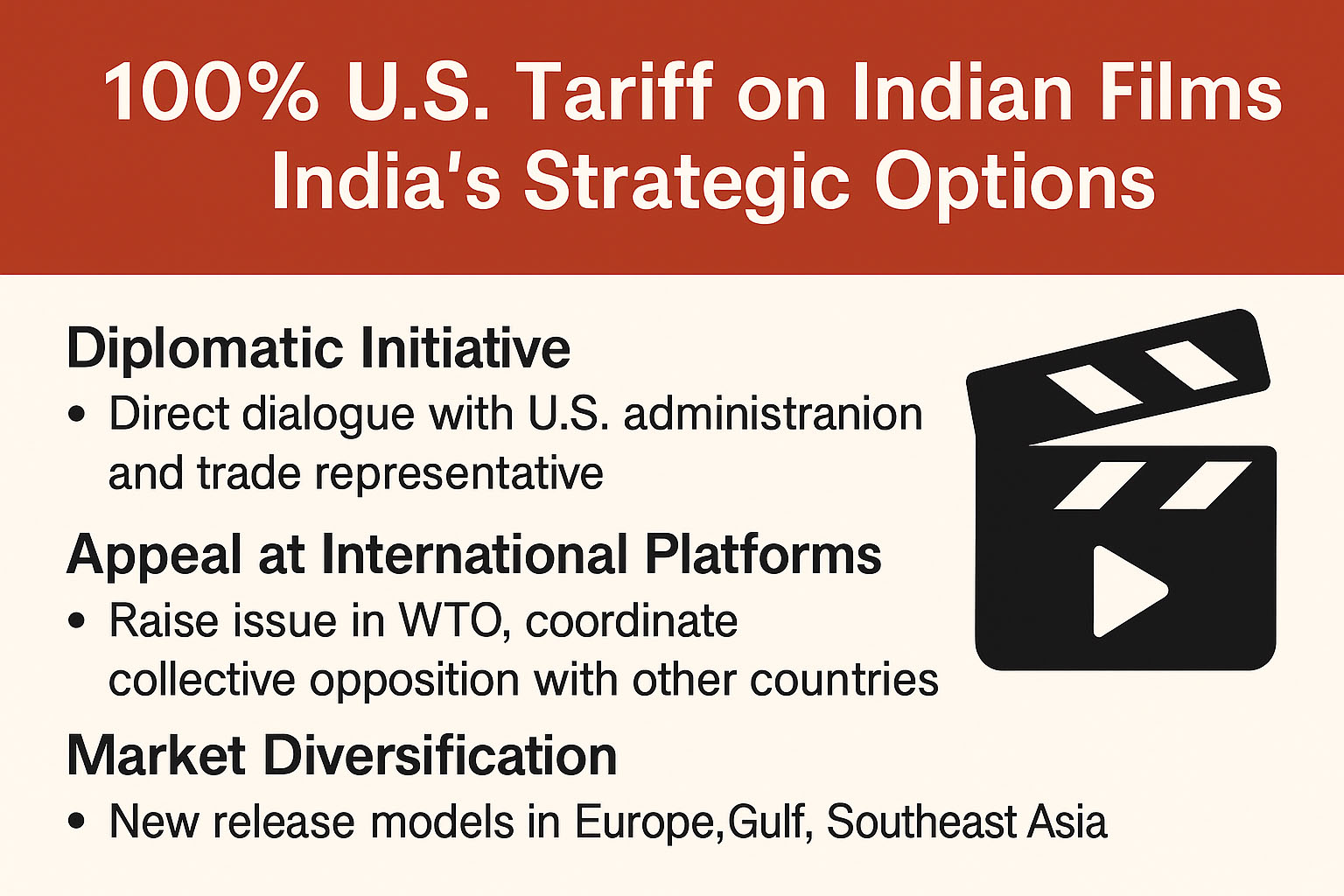
If the U.S. imposes a 100% tariff on all foreign (outside country) movies, including Indian films, here are the key actions India could consider:
1. Diplomatic Engagement
- Direct dialogue with the U.S. government and trade representatives.
- Highlight that films are part of cultural exchange, not just trade.
- Mobilize the Indian diaspora in the U.S. to lobby against the move.
2. Legal & Trade Channels
- File a case in the World Trade Organization (WTO), arguing that this violates free trade rules.
- Work with other affected countries (e.g., France, Korea, Japan) for a joint representation against the U.S. policy.
3. Domestic Support Measures
- Provide tax breaks, export incentives, or subsidies to Indian film producers impacted by reduced foreign revenue.
- Encourage India-U.S. co-productions, which could bypass tariffs if classified as American films.
4. Market Diversification
- Reduce dependency on the U.S. by expanding to Europe, Middle East, Southeast Asia, and Africa.
- Strengthen OTT platforms (Netflix, Amazon, JioCinema, Disney+ Hotstar, Zee5) for global releases, avoiding tariff barriers.
5. Strategic Retaliation (Last Option)
- Consider counter-tariffs on select U.S. imports, but carefully—so it doesn’t escalate into a larger trade war.
6. Long-Term Strategy
- Promote Indian films as global cultural assets through festivals, soft diplomacy, and government-backed promotions.
- Invest in digital-first global distribution models.
- Build co-production treaties with multiple countries to reduce exposure to unilateral tariffs.
👉 In short, India should first use diplomacy and WTO, provide domestic relief, and diversify film markets, keeping retaliation as a last resort.
Would you like me to also prepare a short policy-style note in Hindi, similar to the image poster I made earlier, summarizing India’s response options?
India’s Strategic Response to 100% U.S. Tariff on Foreign Films
Background
The United States has announced a 100% tariff on all foreign films, including Indian movies. This measure, if implemented, would double the cost of releasing Indian films in the U.S., significantly hurting their commercial viability. The U.S. is currently one of the top overseas markets for Indian cinema, driven largely by the large Indian diaspora and growing interest among global audiences.
This policy has economic, cultural, and diplomatic implications. Indian films are not just entertainment exports; they are a critical part of India’s soft power and global cultural identity.
Key Risks
- Economic Impact
- Higher distribution and ticket costs → reduced box office collections.
- Mid-budget films may withdraw from the U.S. market.
- Producers lose millions in overseas revenue streams.
- Industry Pressure
- Multiplex chains, distributors, and streaming platforms may renegotiate contracts.
- Reduced foreign revenue weakens reinvestment into new projects.
- Cultural Setback
- Reduced visibility of Indian films in the U.S. → weakened global cultural influence.
- Diaspora audiences may feel disconnected.
- Wider Trade Implications
- Could trigger broader trade frictions, affecting goods and services beyond films.
Recommended Actions for India
1. Diplomatic & Bilateral Dialogue
- Initiate urgent talks with the U.S. Trade Representative and Department of Commerce.
- Emphasize the role of cinema in cultural diplomacy and people-to-people ties.
- Seek exemptions or reduced tariffs for films under cultural exchange agreements.
2. Leverage International Platforms
- Challenge the move at the World Trade Organization (WTO) under rules on unfair trade restrictions.
- Collaborate with other major film-exporting nations (France, South Korea, Japan) for a joint opposition.
- Use platforms like UNESCO and G20 cultural forums to highlight the unfairness of such tariffs.
3. Domestic Policy Measures
- Provide tax rebates and subsidies to producers hit by overseas losses.
- Launch a Film Export Promotion Scheme to help films access new markets.
- Encourage India-U.S. co-productions, so films partly qualify as American and avoid tariffs.
4. Market Diversification & Innovation
- Expand aggressively in Europe, Middle East, Southeast Asia, and Africa.
- Partner with OTT platforms for direct-to-consumer global releases.
- Explore simultaneous multilingual releases to capture wider audiences.
5. Industry Collaboration
- Film associations (Producers Guild


Honestly one of the most honest platforms I’ve encountered. Withdrawals are processed without any drama. Big thanks to rwin888!
The app version is so much better than the browser. It is fast, secure, and very convenient for gaming on the go via superjililoginapp.
Such a fun experience! The promotions they offer are actually fair and the registration process was a breeze. I am loving the vibes here. jilibeecasino
Hi my friend! I wish to say that this article is amazing, nice written and include approximately all vital infos. I’d like to see more posts like this.
Top notch customer service and very fair odds. It feels like they actually care about the players here. I love using vnqu88 for my daily fun.